
Finding Ellis County Residents
Ellis County does not keep one current roll of every person. Begin with the sort of fact you need to confirm. A parcel account may connect an owner name with a situs address. A recorded deed may place a person in a grantor or grantee role. A voter record supplies registration and precinct context. A printed directory gives a dated household snapshot. Each source answers a narrow question, so matching names alone is not enough.
For a current address question, begin with the county map and appraisal layers, then test the parcel against the clerk’s index. For a historical question, begin with a dated directory, tax roll, cemetery lead, or newspaper item and work toward an original record. The county and its cities use different systems. A Waxahachie permit, an Ennis court entry, and an Ellis County instrument should each be requested from the office that created it.
- Search the address in the Ellis County GIS portal and save the selected address, map date, and visible boundary layers.
- Check the same place through ECAD, keeping the situs and mailing fields distinct when they appear.
- Use Acclaim to search the relevant party, date range, and document type, then retain the instrument or volume and page.
- For an earlier household, compare the closest available city-directory years, tax rolls, and library or archive material.
- When a required record is absent online, make a focused Texas Public Information Act request to its responsible custodian.
Note: A result can be a useful lead without proving present occupancy, identity, or a family relationship.
Ellis County Resident Records Offices
The three most useful local starting points serve different purposes. The Ellis County Clerk records deeds and other official instruments, keeps county-court and probate divisions, and handles qualifying local vital records. Ellis Central Appraisal District supplies appraisal and taxing context for a parcel. County GIS and 9-1-1 Addressing manages mapping, roads, address data, and boundary layers. Use the clerk’s record when the question is about a recorded document, not merely a map label.
Ellis County Voter Registration is another distinct route. Its status process and public-list rules are governed by Texas election law, including confidentiality limits. The office is useful for registration and precinct information, not as a general household roster. A separate street-directory search handles the detailed address sequence.
Ellis County Clerk
109 South Jackson Street
Waxahachie, TX 75165
972-825-5070
Ellis Central Appraisal District
400 Ferris Avenue
Waxahachie, TX 75165
972-937-3552
Ellis County Voter Registration
204 East Jefferson Street
Waxahachie, TX 75165
972-825-5195
Ellis County Parcel and Map Trail
ECAD is the appraisal layer and the County Clerk is the recording layer. That distinction prevents a common mistake in resident research. An ECAD account can supply current appraisal context, a situs address, a mailing relationship, values, and taxing units when those fields are public. It does not replace a deed. County GIS adds an address selection, road and boundary context, and map products, while the Clerk’s Acclaim index supplies recorded parties, dates, instrument references, and legal descriptions.
The official ECAD entry point is the beginning for a parcel inquiry. Its crawler-visible entry screen did not expose the live field labels, so no unverified search controls are presented here. If a needed existing record is not available, ECAD’s request form allows pickup, mail, fax, email, or another delivery method. The form states letter copies are $0.10 per page and maps are $15 without aerial imagery or $20 with it.
ECAD’s property-search entry point is shown below.
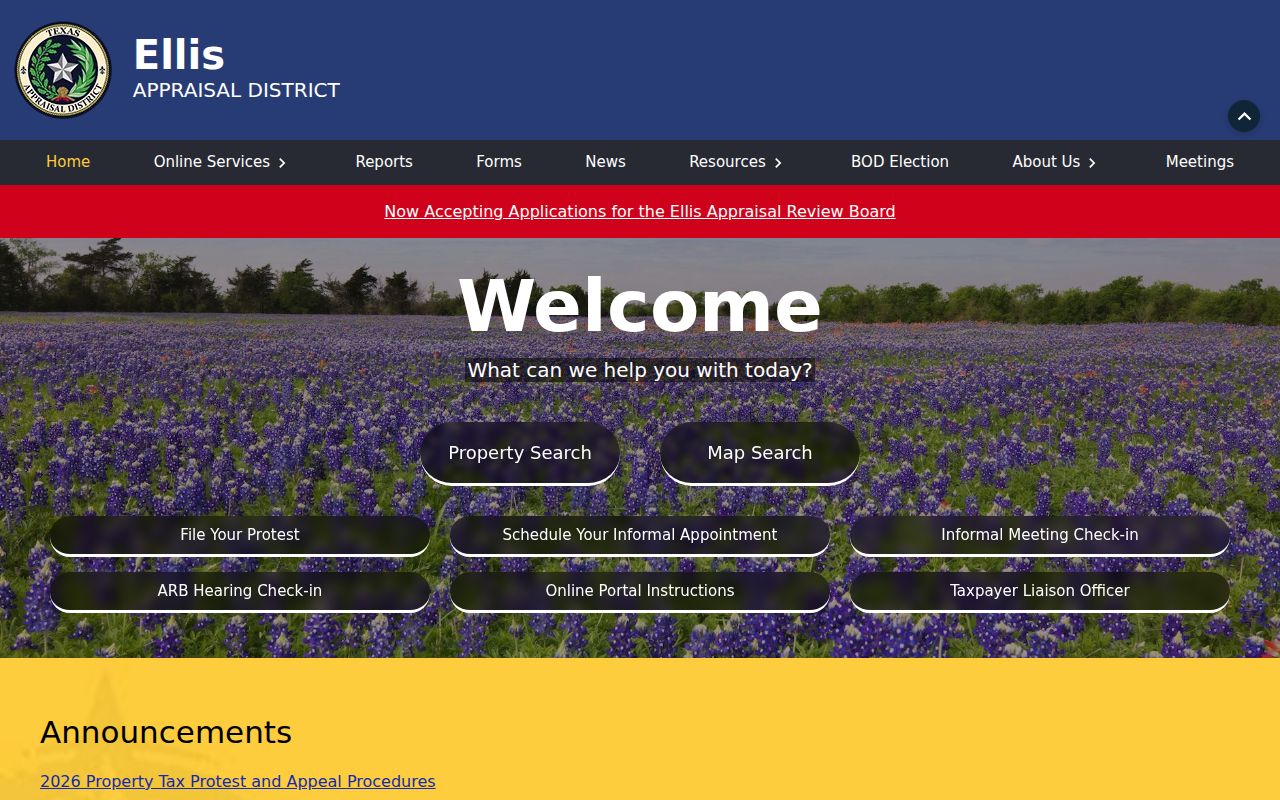
Use a map or appraisal result as a place clue, then preserve the legal description and recording reference before moving to the official-record index.
Ellis County Deed Index Roles
Acclaim separates a name hit from the underlying image. The inspected name form accepts a personal or business name, Starts With, Contains, or Exact matching, a date range, party role, and document type. The form lists All, Grantors, and Grantees as role choices and offers 22 document-type choices. A personal search is formatted LASTNAME FIRSTNAME. Its displayed default date range runs from January 1, 1775 to the current date, but that is a search control, not proof of continuous digitized coverage.
Guest users can search the index and see previews. The county’s instructions distinguish that access from full-image access, which needs a registered account and can involve subscription or transaction rules. Record the document type, recording date, instrument number, volume and page, legal description, and each party’s role. A grantor may be a seller, trustee, lienholder, or estate representative. A grantee may be a buyer, trust, or organization.
| Acclaim field | Useful search choice |
|---|---|
| Name | Personal LASTNAME FIRSTNAME or business full or partial name |
| Match mode | Starts With, Contains, or Exact |
| Date control | Specific range or listed recent-date options |
| Party role | All, Grantors, or Grantees |
| Document type | Choose from the form’s 22 listed document types |
The Ellis County Acclaim records portal is pictured below.
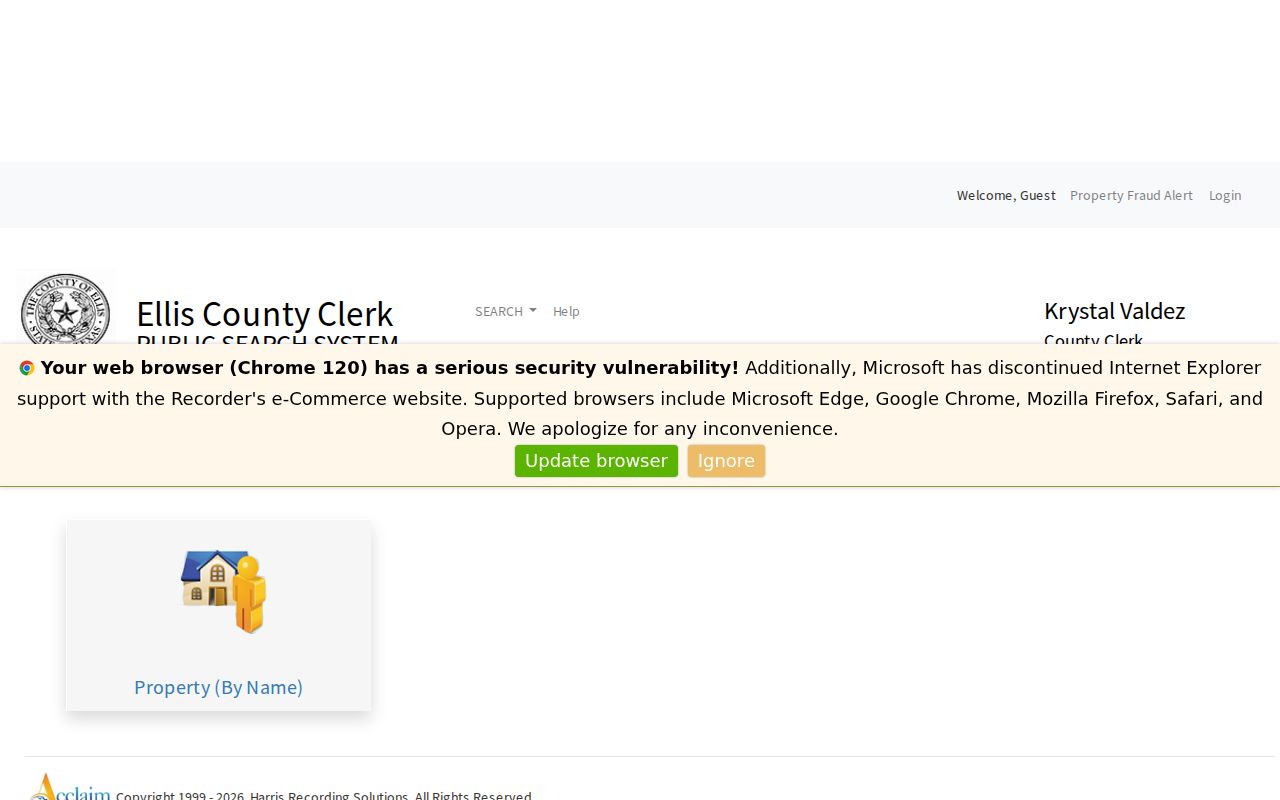
The image reinforces the access distinction: an index result is a lead, while the image or a clerk copy is the source for checking an instrument’s actual text.
Ellis County Voter Record Limits
The Ellis County registrar’s status route and the Texas status portal serve registration questions. The state screen returned a 403 response during automated inspection, so its live form fields were not assumed. County guidance identifies registration, address correction, suspense status, precinct maps, and countywide vote centers. Ellis has 59 precincts since 2022, and the 2025 redistricting action split precincts 1006 and 1038 into new identifiers effective January 1, 2026.
Under Texas Election Code §18.008, a person may request a registration list from a voter registrar, subject to the statute’s notices and confidentiality exclusions. The SOS form documents active and suspense selections, CD-ROM or FTP delivery, and a fixed-width zipped output. Public voter information has protected identifiers and address-confidentiality rules. Treat registration as a dated election record, not proof that a person presently occupies an address.
Texas voter-status lookup is shown in this capture.
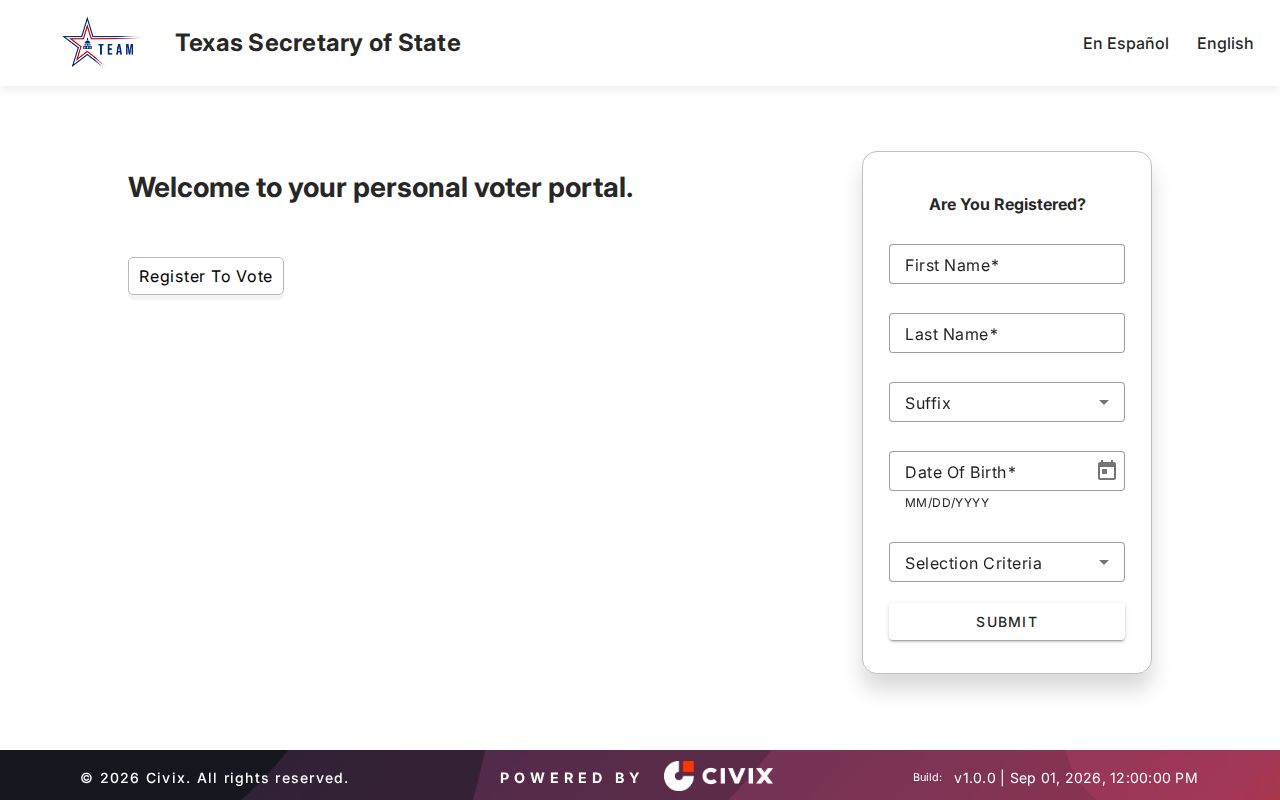
When the live screen changes or a status record needs explanation, the Ellis County Voter Registration office is the local contact rather than an inferred name-and-address match.
Note: Protected voter information and substitute addresses must never be reconstructed from other public sources.
Current Ellis County Resident Sources
Current sources are best read as separate public rolls rather than as a single directory. An appraisal account connects a parcel with recorded owner and mailing information where public. The Acclaim index connects named parties with instruments. The voter system records election registration and geography. Court and probate indexes may show a party’s role in a case. Each has a different date, custodian, and access boundary. When finding one named individual is the goal, the Ellis County resident lookup process helps keep those roles distinct.
| Ellis source | What it can establish | Custodian | Access route |
|---|---|---|---|
| ECAD appraisal account | Parcel, situs and owner or mailing relationship where public | ECAD | Property route or existing-record request |
| Official-record index | Party role, instrument, date and legal land connection | County Clerk | Acclaim guest index and clerk copies |
| Voter registration | Status, precinct and election geography | County registrar / SOS | Status route or statutory list request |
| Court or probate index | Case, party role, filing and disposition context | County or District Clerk | Portal, clerk, or records request |
| Community association certificate | Association name, city, ZIP and certificate lead | Texas HOA database | County and ZIP-filtered search |
Association certificates, public board material, and chamber listings can supply institutional leads. They do not prove a person’s current address or membership. For a historical household, city directories and archive records are stronger time-specific sources than a current parcel entry.
Ellis County Court Search Paths
Court research begins by identifying the right clerk and court. The County Clerk is the route for misdemeanor, civil, probate, guardianship, mental-health, and Commissioners Court records. The District Clerk handles divorces, felonies, passports, and district-court files. Ellis County links its online court-record route through LGS Online Solutions, but the live search form and coverage years were not exposed during research. A missing portal result can reflect an unindexed period, a spelling difference, a restricted file, or a different court.
For a copy or a question about a nonindexed case, contact the appropriate clerk with the court, cause number, name variation, approximate filing year, and record type. Statewide cross-checks have separate roles: TAMES is the appellate route, and re:SearchTX is an account-based trial-record route. Official documents remain with the clerk. A docket is not the same as a pleading, judgment, exhibit, or certified file.
The Ellis County LGS court-record entry route appears below.
The captured screen is an entry point only. It should not be read as confirmation of a case-search field, document image, or date range that the live service has not displayed.
Ellis County Vital Record Windows
Vital records have both date and eligibility limits. The County Clerk says Ellis County birth records reach back to 1850 and keeps county marriage records. Death copies are limited to deaths occurring within Ellis County limits. Texas Department of State Health Services, or DSHS, supplies statewide certificates, verifications, forms, and indexes. Under Texas Government Code §552.115, a birth record becomes public after 75 years and a death record after 25 years. Earlier records require the appropriate qualification, legal authority, or documented direct and tangible interest.
Choose the route that matches the record. A local certified marriage license comes from the issuing County Clerk, and a certified divorce decree comes from the District Clerk. DSHS marriage and divorce verifications are not replacements for those certified local records. DSHS notes that online orders generally take 20 to 25 business days, while mail procedures are generally longer. Its current fee and ID instructions should be checked before an order is submitted.
Texas DSHS vital-record applications and forms are shown here.
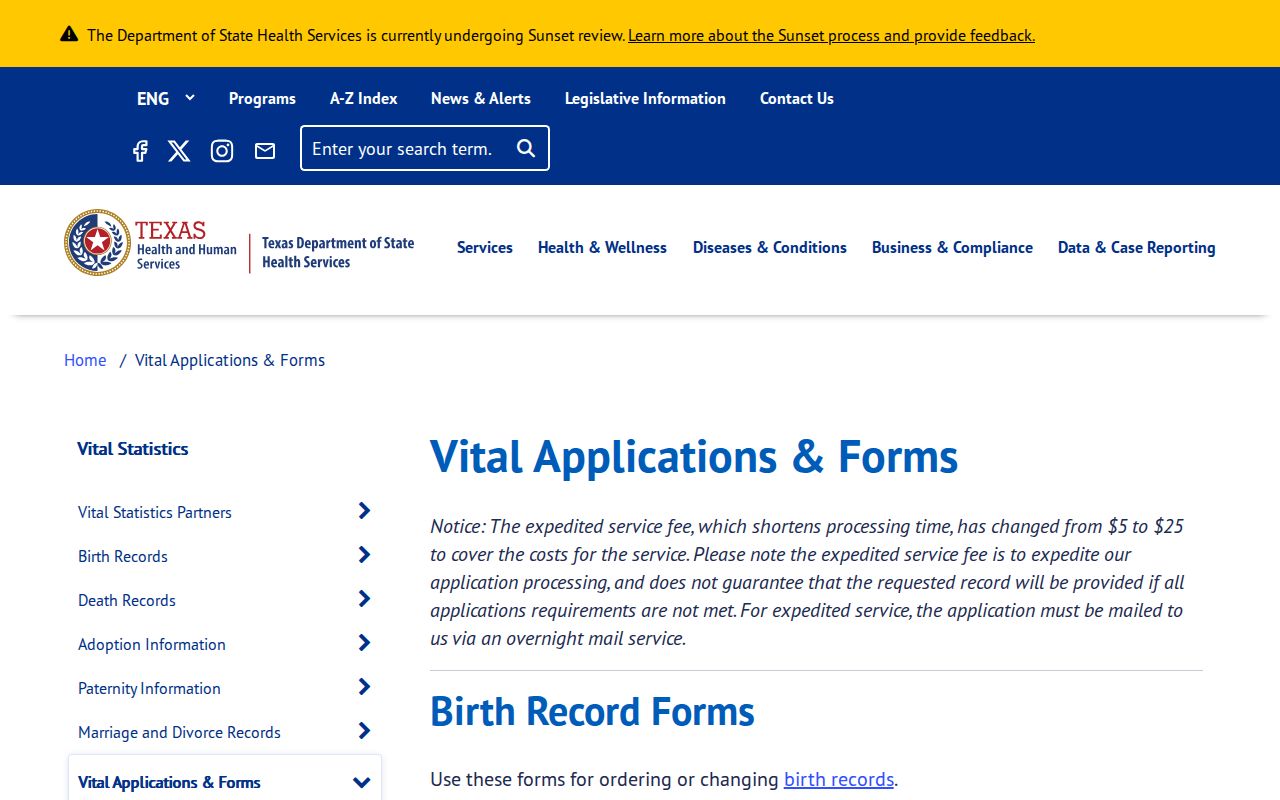
The form directory is useful for choosing the proper application, but eligibility and the needed identification still depend on the record type and date.
Ellis County Historical Record Shelf
Older Ellis research has a strong library and archive route. Nicholas P. Sims Library in Waxahachie holds Reference, Genealogy, and Texas Collections and has a microfilm reader. Its partner collection at the Portal to Texas History includes a digitized 22-volume Ellis County genealogy set, compiled from 1954 through 1970. Volume 1 is 190 pages, spans 1734 to 1952, and starts its index on page 148. The material includes family Bible, cemetery, church, will, marriage, pioneer, school, and biographical entries.
A digitized compilation is a valuable finding aid, but it is not automatically the underlying civil or church record. Keep the volume, page, compiler wording, and record type in notes, then seek the source record when the detail matters. The TSLAC Ellis County guide adds reel-level routes for deeds, tax rolls, probate, marriage, naturalization, school, birth, death, and court series. Many of those records are on microfilm or have incomplete indexes.
- Roll
- A dated list or series created for a particular purpose, such as taxes, voters, or schools.
- Index
- A finding tool that points to a record; it may not include the full image or all original details.
- Criss-cross directory
- A directory arranged by street or address rather than only by name, when a collection includes that section.
- Parcel
- A mapped piece of land identified for appraisal or legal-description work; it is not a household list.
Note: Preserve the source type because a map, compiled volume, and certified record each establish different facts.
Ellis County License and Name Checks
A Texas license or business filing can test a specific claim, but neither is a resident directory. TDLR’s public search is available by name, license type, city, or county and can show a credential type, number, expiration, and county. Some professions use separate state-board routes. SOSDirect covers state business filings, while an Ellis County assumed-name certificate is a separate County Clerk filing. Compare legal name, filing date, address type, and record status before joining those results.
Texas Department of Licensing and Regulation’s public-search gateway is captured below.

That gateway helps locate a state credential route. It does not establish an Ellis County residence unless the record itself supplies a relevant dated location field.
Ellis County ZIP and Privacy Boundaries
ZIP codes are mail-delivery tools, not parcel boundaries. Ellis County evidence identifies routes for Bardwell, Ennis, Ferris, Palmer, Red Oak and Ovilla, Waxahachie, Forreston, Maypearl, and Midlothian, but a ZIP can cross a county or city edge. Verify a delivery address with USPS, then use County GIS for 9-1-1 and district context, ECAD for appraisal context, and the Clerk or plat for the legal description. A ZIP result never identifies a person.
Texas confidentiality rules also set hard limits. The Attorney General’s Address Confidentiality Program can provide eligible participants a substitute mailing address. Voter programs and statutes protect certain identifiers and residence details. Do not reconstruct a protected address from parcels, directories, or other records. Texas Public Information Act requests seek existing government records, not a new database or a research service. The request should name the record, likely custodian, date range, and desired format.
Ellis County Historical Resident Directories
Waxahachie directory holdings are intermittent rather than a continuous annual run. The 1985 Historic Resource Survey identifies a 1895 to 1896 directory, 1907, 1922, 1927 to 1928, and 1942. The survey names Enterprise Publishing Company for 1907, Texas Directory Company for 1922, Coward Directory Company for 1927 to 1928, and Dilday Directory Service for 1942. Those windows can place a household at an address in a publication year, but they cannot prove a move date between volumes.
Compare the alphabetic entry with any street section in the same volume, then repeat with the next available year. The 2004 Waxahachie survey documented a 1942-to-1955 directory comparison for tracking postwar block change. Pair that result with the 1950 public census, a deed, tax roll, Sanborn sheet, or permit record as appropriate. The Ellis County city directory collections have the fuller shelf and tracing method.
Ellis County Records Through Time
Ellis County’s physical records history explains why access methods differ by era. The county was established in 1849, and Waxahachie became the county seat in 1850. The first Commissioners Court met in August 1850. The present Historic Courthouse dates from 1897 and has a record-safe vault and metal shutters. Its restoration story is a practical reminder that preservation, storage, and later imaging affect whether a record is found in an online index, a courthouse book, or a reel.
The TSLAC guide shows a mixed surviving record pattern rather than one simple loss event: deeds from 1845 to 1901, tax rolls from 1850 to 1910, and many other series with some unavailable or incompletely indexed volumes. For a historic Waxahachie place, the July 1890 Sanborn map, the 1946 official city map revised from 1896 and 1922 sources, a directory, and a deed can form a dated chain. The value comes from keeping each source’s date and purpose visible.