
Ellis County City Directory Holdings
The clearest local directory evidence comes from the 1985 Waxahachie Historic Resource Survey. It identifies a group of printed Waxahachie titles, but not a continuous yearly run. That distinction matters. A missing name may reflect a missing edition, a different spelling, or a household outside the publication area. The Texas State Library and Archives Commission city-directory research page also describes the common fields in these books and points researchers toward catalog-based access. Confirm the physical shelf or scan before treating any listed title as available on a particular day.
| Collection or title | Years identified | Where to begin | Access route |
|---|---|---|---|
| Waxahachie city directories in the 1985 survey | 1895-1896, 1907, 1922, 1927-1928, 1942 | Survey holding list and local-reference inquiry | Confirm the title and shelf before a visit |
| Texas State Library directory collection | Catalog-dependent | TSLAC Austin Reference Reading Room | On-site research; staff do not conduct phone searches or scan every page |
| UNT Portal directory route | Search by county and date | Portal to Texas History catalog | Online when a digitized title is available |
| 1927-1928 catalog lead | 1927-1928 | FamilySearch catalog route identified in research | Verify image access before relying on it |
The sequence starts with 1895-1896, then jumps to 1907, 1922, 1927-1928 and 1942. The survey does not identify a final printed year. A 2004 survey used a 1955 directory in its research method, yet its publisher and shelf record were not independently captured. Treat the 1955 reference as evidence of later research material, not as a promise of a readily available volume.
Note: Record the title, year, page, and section before copying a name into family notes.
Ellis County Printed Directories at Sims
Nicholas P. Sims Library & Lyceum in Waxahachie is the practical local starting point for an uncertain directory title. Its public description names Reference, Limited Access, Genealogy and Texas Collections, along with a microfilm reader. The library also combines county publications, newspapers, vertical files, and reference help. Ask the desk for the exact year, a surname, and any known address. That is more useful than asking for a general resident list, because no complete public year-by-year reverse-directory inventory was found on the public pages.
The posted location is 515 West Main Street, Waxahachie, and the listed phone is 972-937-2671. Research recorded current hours as Tuesday through Friday 9-7 and Saturday 9-5, with Sunday and Monday closed. Hours can change, so verify them with the library before travel. The genealogy and reference contact route also accepts questions about printed directories, microfilm, funeral notices, yearbooks, cemetery files, and local newspaper material.
The Sims Library genealogy and reference page shows the local library context used for Ellis County historical-directory work.
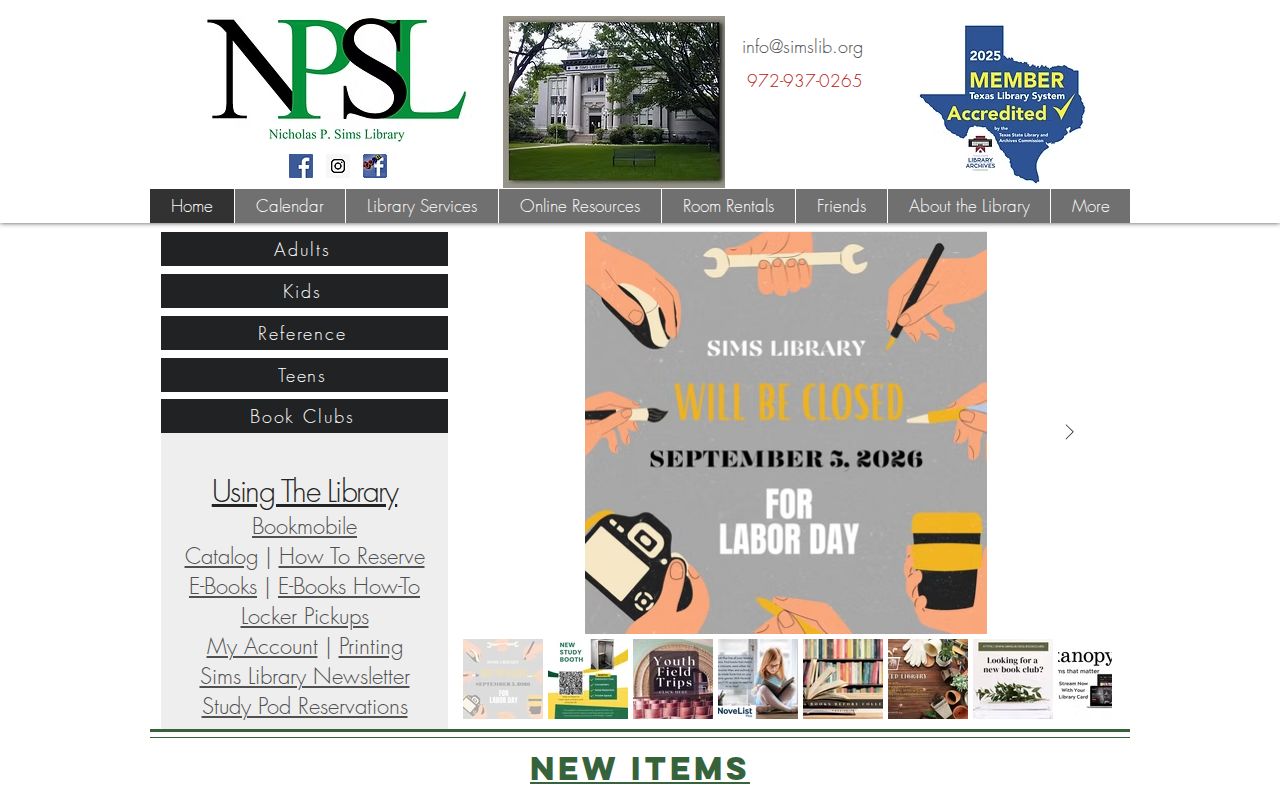
Its genealogy desk and microfilm capability make it a useful fallback when a directory is neither searchable online nor available as a stable scan.
Ellis County Historical Holding Gaps
One of the most important facts about the Ellis County historical-directory trail is its uneven rhythm. The identified Waxahachie holdings skip between five windows rather than documenting every year. That is a useful warning, not a dead end. Search initials, married names, surname variants, and nearby years. Then compare an absence against a census, a deed party, a newspaper notice, or a cemetery record before deciding that a household left town.
City boundaries also matter. Ellis County includes many municipalities, and a person associated with Ennis, Midlothian, Red Oak, Ferris, Palmer, Italy, Maypearl, or a smaller community may not appear in a Waxahachie title at all. The record’s jurisdiction on the publication date controls the search. A dated directory is not a countywide register.
The 1985 Waxahachie Historic Resource Survey is the source for the identified directory windows and their listed publishers.
The TSLAC city-directory research page supplies the catalog and research context for the digitized-directory capture.
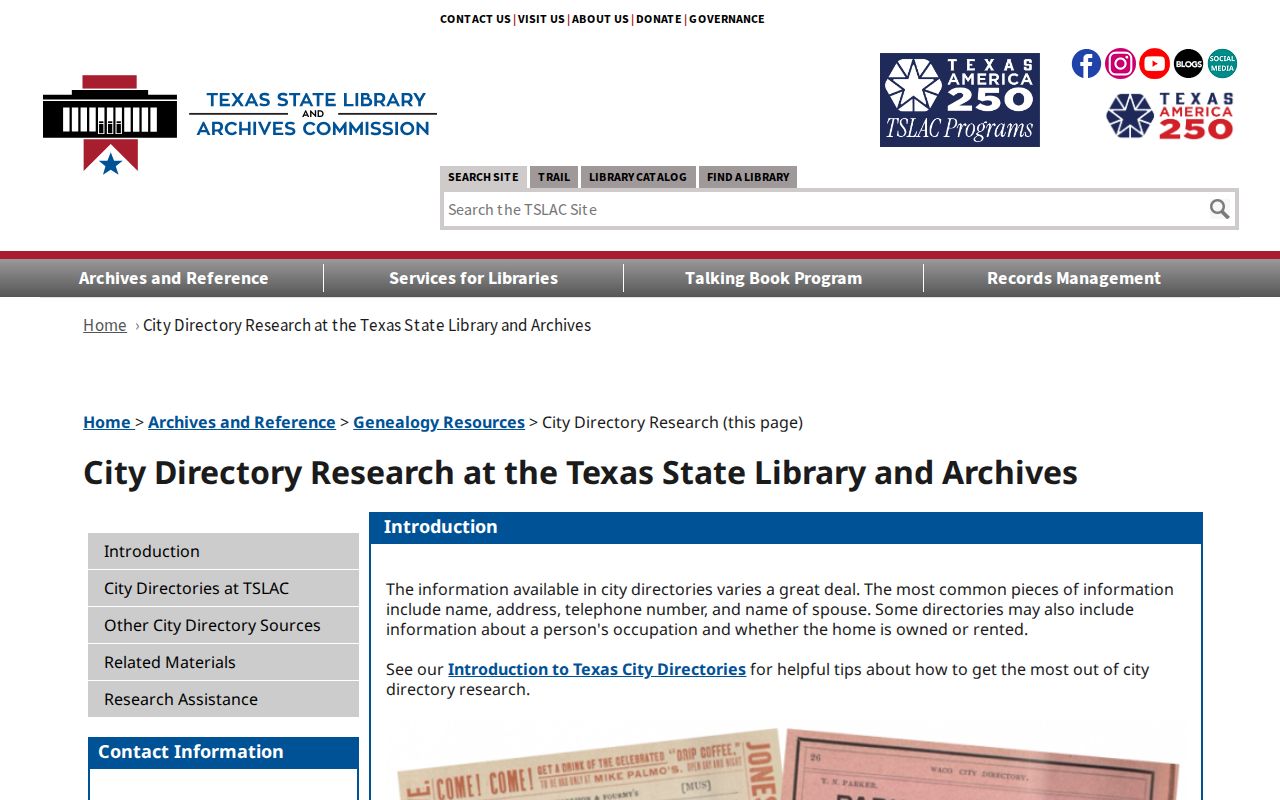
Catalog and digitized-directory routes help locate a title, but each scan still needs a year and page citation before it supports an address claim.
Read an Ellis County Historical Entry
The TSLAC research guide describes the vocabulary commonly found in a city directory: a name, street address, telephone, spouse, occupation, owned-or-rented notation, and sometimes a business line. The unattended source review did not capture a live Waxahachie page, so any local abbreviation must be read from that volume’s own key. Do not assume that an abbreviation has the same meaning in every publisher’s book.
| Person name | Copy initials, spelling, and the alphabetic-section heading exactly as printed. |
|---|---|
| Address | Record the street number, street name, unit or rear notation, and any intersection wording. |
| Household notation | Preserve spouse, relationship, widow, boarder, hotel, institution, or vacancy wording when printed. |
| Work or business line | Keep the wording as an identification clue, not proof of a current address. |
| Ownership mark | Use it only after checking the abbreviation key in that exact edition. |
- Criss-cross directory
- A street-order section that can list an address before the people or businesses recorded there.
- Householder index
- An index organized around the named household, rather than a full census of every person at an address.
- Abbreviation key
- The publisher’s explanation of shorthand. Photograph or transcribe it before interpreting entries.
A directory entry can identify a publication-year address. It does not by itself prove ownership, continuous occupancy, or a modern location. For a current address chain, use the separate Ellis County Street Directory route and compare the legal parcel record.
Ellis County Genealogy Volume Companions
Historical directories are stronger when paired with a source that answers a different question. The Portal to Texas History hosts a digitized 22-volume Ellis County genealogy collection compiled by Mrs. A. L. Feltenberger and the Rebecca Boyce Chapter DAR between 1954 and 1970. Its 23 digital items include family Bibles, church and cemetery records, wills, marriages, pioneer material, schools, biographical sketches, and military material. Those are compiled leads, not replacements for the original church, clerk, cemetery, or probate record.
The digitized Ellis County genealogy collection gathers those volumes under stable Portal to Texas History records.
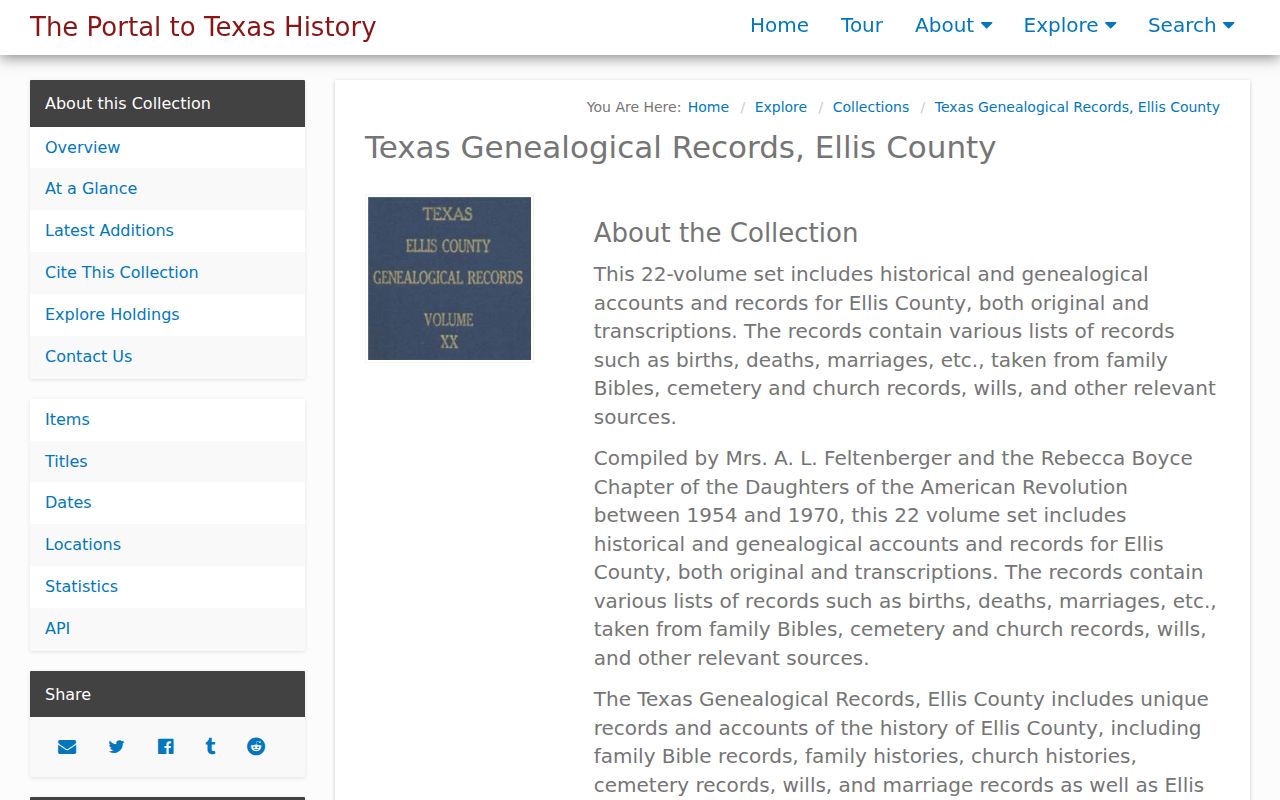
A compiled reference can point to a useful surname or date, while a city directory provides the publication-year address snapshot needed for a household timeline.
Volume 1 is particularly bounded: it covers 1734-1952, has 190 pages, and begins its index on page 148. Preserve both the volume and page when using it. The collection’s compiler spelling belongs in the notes even when another record uses a different spelling.
Ellis County genealogy Volume 1 is a page-viewable source rather than a general web summary.
Use its family and local-history entries to form a source question, then test that question against the relevant original record or dated directory.
Compare Ellis County Directory Years
The 2004 Waxahachie historic-resource survey gives a local method worth repeating. Its researchers compared 1942 and 1955 directories to identify postwar neighborhood changes from 1945 to 1955. That comparison does not create a continuous list of occupants. It does show why two dated books can reveal a move, a new block pattern, or a changed business address when each entry is read in context.
- Locate the person or address in the first available edition and copy the complete entry with its page number.
- Check the street or reverse section, when the volume has one, for nearby household and unit notations.
- Move to the next available local directory year, allowing for a spelling change, marriage, widowhood, or a missing edition.
- Pair the directory snapshot with the closest public federal census. The latest fully public decennial census is 1950 under the 72-year release rule.
- Use a deed, map, obituary, cemetery record, or probate file to test what the changed entry means.
A census is a one-day enumeration. A dated directory is a publication-year snapshot. They often complement each other, but neither erases the limits of the other. The historical shelf belongs to directory research; a backward parcel chain belongs with Ellis County previous residents research.
Ellis County Archive Research Beyond Books
When a directory year cannot be found, the TSLAC Ellis County microfilm guide supplies a different dated trail. It identifies deeds from 1845-1901 with direct and reverse indexes, tax rolls from 1850-1910, marriage records from 1850-1934, probate material, naturalization series, and scholastic censuses from 1933-1947. Many of those sources are reel-only or incompletely indexed. Save the reel, volume, page, and index type along with the name.
The guide expressly cautions that some deed series were transcribed and may not be accurate. That is a reason to verify a name against the filmed or original page, not to discard the index. Older land records may use a lot, block, subdivision, survey, or adjoining-owner description instead of a familiar street address.
Note: A microfilm index creates a lead; the underlying page is the record to cite when details matter.
Ellis County Directory Names in Newspapers
A directory line often becomes more useful when it is set beside local reporting. The Portal to Texas History’s Ellis County Area Newspaper Collection contains 4,511 digitized items dated from 1900 through 1917, including the Waxahachie Daily Light, Ferris Wheel, and Ennis Daily News. Sims also has local newspaper microfilm and vertical files. A notice may supply a date, organization, obituary clue, or street reference that helps distinguish two people with the same name.
Keep source types separate. A printed notice is a published account; a cemetery entry is an interment clue; a compiled genealogy volume is a reference lead; a clerk record or certificate may provide a different level of proof. Searching initials, nicknames, and married names can help, but silently correcting a source’s spelling can hide an important distinction. Save a newspaper issue date and page with the directory year. That small habit makes it possible to return to the original source when later evidence conflicts.